
A&E Negligence
In 2025, Stewart House received 2% of it’s work in relation to Accident and Emergency negligence. Sepsis was the largest occurrence closely followed by misdiagnosed fractures.
Interestingly, delayed diagnosis of a stroke is one of the fewest types of cases we have been asked to provide evidence on.
Lets take a look at the two highest ranking areas of negligence that we have been asked to report on:
SEPSIS
In a joint study between Negligence Claimline and Stewart House Limited, 500 people were asked questions about the medical condition Sepsis. Here is what that study showed.
Sepsis has now overtaken Breast, Bowel and prostate cancer in the amount of lives it takes, and is getting worse in Western countries.
Despite the fact that sepsis kills over three times as many people as breast cancer in the UK alone, only 20% of people know how deadly it is
What's more, 25% of people actually think breast cancer is more deadly
Sepsis, a condition triggered by infection or injury, normally presenting as blood poisoning, now kills an estimated 48,000 people in the UK, overtaking lung cancer, the second biggest cause of death (according to the most recent statistics authored by the NHS).
Globally it kills 11 million people a year, the equivalent of one death every 2.9 seconds.
Yet, despite this, very few people know how deadly it is
Asked out of the five conditions which was the most deadly, only 20% of 500 participants correctly identified sepsis.
Despite being three times more deadly than breast cancer, 25% of people said that breast cancer was the most deadly condition out of the following choices, when asked "which condition do you think has the highest mortality rate?".

The answers given show that people under-estimate the deadliness of sepsis and over-estimate the deadliness of other conditions.
UK Mortality rates:

Only 24% of 500 participants could correctly identify three signs of sepsis. 54% of people mistakenly thought sepsis symptoms were stroke symptoms. 11% said meningitis and 8% said heart attack:
What's clear, is that sepsis awareness is low despite the fact that people tend to have some familiarity with the term.
When asked "What is sepsis?" 70% of people could identify it as “blood poisoning”. Here are the results:

Worryingly, it is lack of awareness that lets sepsis develop into the serious condition that is robbing the UK of so many lives.
Sepsis is very treatable – but both the general public and medical professionals are missing the signs.
If caught early sepsis can be treated easily with a simple course of antibiotics, but if left untreated it can become very serious and even fatal. At the moment, this happens in NHS hospitals.
Misdiagnosis or missing sepsis altogether is contributing to “excess deaths” from severe infections like sepsis.
13,000 excess deaths according to the NHS could have been avoided had signs been spotted early and different treatment administered.
The NHS has acted upon sepsis figures and is currently implementing best practice standards to ensure staff are prepared for sepsis.
But one of the major challenges in sepsis identification is that it looks like lots of other illnesses and can have broad symptoms. For example, sepsis has many similar symptoms to stroke and is a well-known stroke mimic.
The signs of sepsis:
There are three stages to sepsis development:
1. Sepsis involves fever, a high heart rate, fast breathing and evidence of an infection:

2. Severe sepsis includes the following signs:

3. Septic shock is the final, serious stage where all the symptoms of severe sepsis combine with a low blood pressure.
Missed diagnoses of fractures
In 2022, NHS Resolution (the body responsible for defending claims for compensation following an act of medical negligence) reported that, in 2018/19 there were 1,147,822 attendances at A&E where the primary diagnosis was classified as dislocation/fracture/joint injury or amputation which accounts for 5.1% of total A&E attendances.
In a review of 78 successful claims relating to incidents relating to missed fractures between 2015 and 2018, the costs including both claimant and defendant legal fees were calculated at £1,118,972.
The average costs per claim was £14,346 which was split into NHS legal costs £1,535, Damages £6,021 and claimant legal costs £6,790.
The report went on to say that of the 78 successful cases, 64% (50 people) were x-rayed whereas 36% (28 people) were not x-rayed. Of the 50 people who were x-rayed, 43 people were misdiagnosed due to incorrect interpretation of the x-ray.
The location of the missed fractures were demonstrated by the following image:
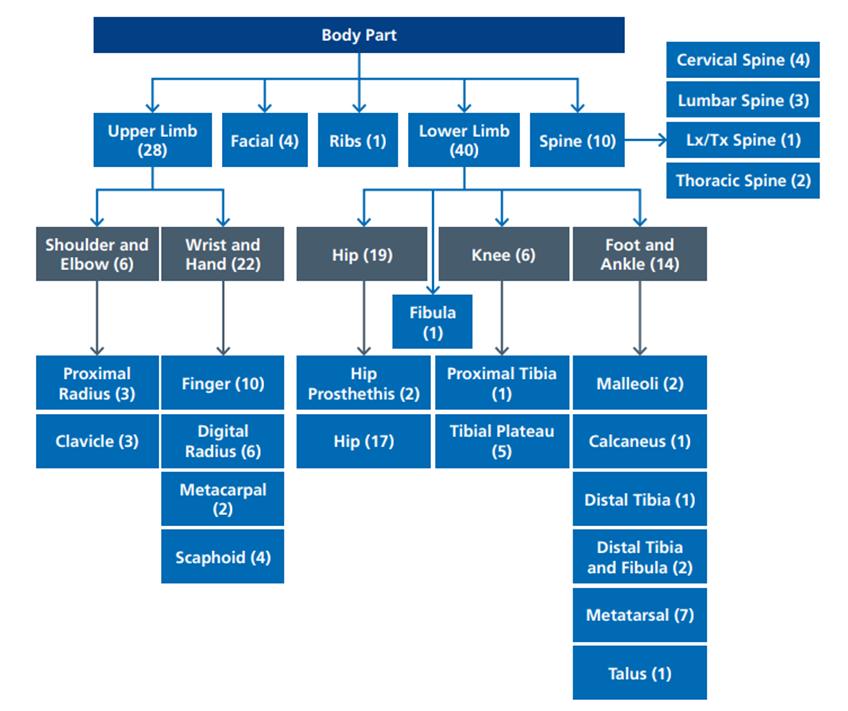
As the diagram above shows, lower limb fractures account for the highest incidence and of those, 19 were related to hips.
Hip fractures are a common injury in elderly people where they have suffered falls. A fall may damage the lateral aspect of the hip and more specifically the greater trochanter which in turn fractures the neck of the femur.

Diagnosis of this type of fracture can be challenging because of technical difficulties in getting high quality images and fractures can be hidden by demineralized bones and degenerative changes.
The next area of most common missed fractures relates to hand and wrist fractures.
The scaphoid bone is the most commonly fractured bone in the carpus (the collection of bones located just below the wrist. It most often occurs following a fall onto an outstretched hand. Scaphoid fracture diagnosis can be difficult because they may not appear on plain x-rays and therefore multiple view x-rays, scaphoid series should be used. MRI Scans should also be used as a first-line diagnosis technique.
Though claims relating to missed fractures are low in numbers and financial value, they can have serious and long term impact on the patient.
It is reported on the openaccessgovernment.org website that National Institute for Health and Care Excellence (NICE) recently announced that AI technology has the potential to significantly reduce the number of missed fractures on X-rays.
By analysing the images, AI algorithms can identify subtle signs of fractures that human experts may overlook.
If you are investigating claims in an A&E setting, Stewart House has the expertise and expert panel to cover all areas.



Comments